

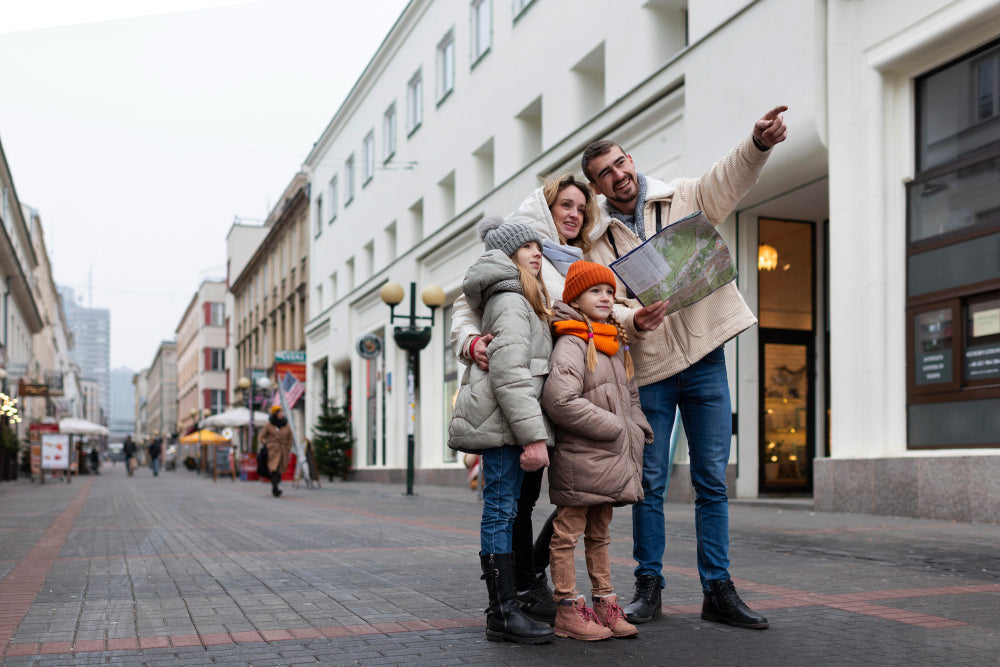
If you're the type of person who gets bored quickly with guided tours and scripted explanations, urban treasure hunting is probably right up your alley. Instead of following a flag in the distance, the city becomes your playground, and you're the main character. Let's take a real look at why it's worth discovering a new city through a treasure hunt.
1. You learn the city on the go, not from brochures
If you just wander around, you risk getting stuck between two commercial streets full of the same brands as back home. In a treasure hunt, clue after clue, you're pushed towards old markets, hidden passages, facades you'd otherwise walk past without noticing. Instead of "checking off landmarks," you start to understand how the city pulses: where locals gather, which shortcuts they take, which corners they love—not just the guide. When you get back to your accommodation in the evening and put your finger on the map, you realize you've already done a pretty good "scan" of the downtown area.
2. You turn your visit into a game (and your brain loves it)
Our brains respond much better to challenges than to to-do lists. When you receive a riddle, a code, a symbol you need to decode, you automatically enter "game mode." You're no longer "visiting" the city, you're playing it. Point systems, time limits, missions, or "bonuses" aren't just marketing gimmicks—they're real mechanisms that boost your motivation, attention, and level of engagement. Instead of dragging yourself after a group, you're the one pulling the group forward: "Come on, we still have two more clues to find!"
3. You discover places that classic guides ignore
A well-designed treasure hunt doesn't just take you past the cathedral and main museum. It leads you through interior courtyards, painted alleyways, side staircases, small memorial plaques you'd never notice, hidden cafes, or facades that tell an interesting story. It's the kind of experience where, three days later, you tell friends: "I don't know exactly how I got there, but I discovered an incredible little street near..." Eastern European cities, for example, have tons of such corners—in old areas near train stations, among interwar buildings, in neighborhoods with strong identity. Treasure hunting is the perfect excuse to end up exactly there.
4. You learn history and culture without feeling like you're in homeroom
Many treasure hunts are designed as mini "walking courses": at each point, you learn something about a building, a character, a local custom, a tradition, or a historical event. The difference is that information comes at the moment when you actually need it to solve something. You don't read a long panel because "that's what you do," but because you need to find a year, a name, or a symbol that helps you move forward. Basically, the city becomes your history textbook, and you take the test in the field, not at a desk.
5. It's one of the best group activities (without forced small talk)
If you've ever been on a city break with multiple friends, you know there's always a risk of splitting into camps: some want museums, some want shopping, others just want cafes. Treasure hunting is a bridge between all these styles. You have a common goal, you have something to solve together, inside jokes emerge, discussions about clues, amusing little "ego battles." Instead of sitting on your phones at the table, you look at a statue and debate whether what's written on the pedestal is the right answer or not. For companies, it's the kind of team building that actually gets people moving through the city, not just stuck in a conference room with colored sticky notes.
6. It works for all ages and types of travelers
One of the great advantages of urban treasure hunts is flexibility. You can do a route designed for families with children (more game, less text), one focused on history for teenagers or students, or one oriented towards gastronomy and venues for adults. If you're introverted, you can focus on puzzles and observation. If you're extroverted, you take the role of "team captain," talk to locals, coordinate. Everyone finds their place in the game dynamics, without everyone needing to behave the same way.
7. It takes you out of "just photos for Instagram" mode
There's nothing wrong with taking beautiful photos, but it's a shame to reduce a city to just a few frames with famous buildings. During a treasure hunt, photography sometimes becomes part of the game: you have to capture a detail, recreate a scene, photograph an element you can barely make out. Suddenly, you're no longer just photographing the facade, but looking for carved faces, inscriptions, meaningful graffiti, traces of an old workshop or a disappeared business. The result? A photo album where you can see that you paid attention to the city, not just to yourself in front of it.
8. You have freedom and safety at the same time
Treasure hunting gives you a route and logical thread, but doesn't tie you to a physical guide or rigid schedule. You can take a coffee break, stay longer in a place you like, skip a point if it doesn't resonate with you. At the same time, you know you won't get completely lost, because the game is designed to bring you back to a familiar area and usually offers "backup clues" in case you get stuck. For busier cities, it's a good way to move through relatively safe areas, already tested by other players, not completely randomly.
9. It supports the local economy, not just big chains
Many treasure hunt routes deliberately include points that take you to small shops, craft workshops, independent bookstores, neighborhood cafes, or local markets. Sometimes, one of the missions is actually to enter such a place, ask something, discover an object, taste a product. Beyond entertainment, this means your money also goes to local entrepreneurs, craftspeople, and people who actually keep the city's character alive. Basically, the game becomes a subtle channel for redirecting tourist flow from "the same three places" to more diverse areas.
10. You create stories to tell later, not just "it was nice"
Think about the last cities you visited. How many of them do you remember clearly and how many remained in a fog of "yeah, I was there, nice"? Treasure hunting has the talent of producing memorable moments: the funny reply of a local who helped you, the clue you interpreted completely wrong, running to the last point to "beat the clock," that feeling when all the pieces finally come together. Exactly these kinds of fragments turn into stories you retell years later. You don't just say "I visited city X," but "I had a mission through city X and almost lost because of a statue we didn't see in time."
Frequently asked questions about discovering a city through a treasure hunt
Do you need a lot of preparation before participating in an urban treasure hunt?
No. Generally, you just need your phone (if the game is digital), some battery, comfortable shoes, and a little curiosity. The organizer gives you basic instructions, and you learn the rest "on the go." If you want to be extra prepared, you can take a quick look beforehand at the area where the route takes place, but it's not mandatory.
What happens if you don't find a clue or get stuck on a hint?
You're not taking an exam, you're in a game. Usually, there are additional clues or "skip" options that let you move forward without ruining the experience. In some treasure hunts you can even contact the organizer for a little "hint." The important thing is to have fun, not to check off 100% perfect solutions.
Is a treasure hunt suitable for families with children?
Yes, very much so. Many routes are designed especially for families, with visual challenges, simple activities, and stories they can understand. Children get to run, observe, ask questions, and participate actively, not just be "dragged" after adults. It's basically a long walk that you don't have to sell as a walk, but as an adventure.
How do you choose a good treasure hunt in a new city?
Look at a few things: who organizes it (tourism office, museum, specialized company), what area it covers, how long it lasts, what difficulty level it has, and what age/group it's recommended for. Reviews from other participants are gold. If you see people saying they discovered interesting places, that the clues are clear but not trivial, and that the route is well designed, you're probably on the right track.
Is an urban treasure hunt a safe activity?
Largely yes, as long as you follow common sense rules: cross where you should, don't enter obviously sketchy areas, don't ignore the organizer's instructions. Most games are designed for tourists and groups, so routes go through relatively busy and known areas. If you have children with you, it's enough to establish a few simple rules at the beginning (we go together, we don't run in the street, etc.) and you'll turn the city into a controlled adventure park.