

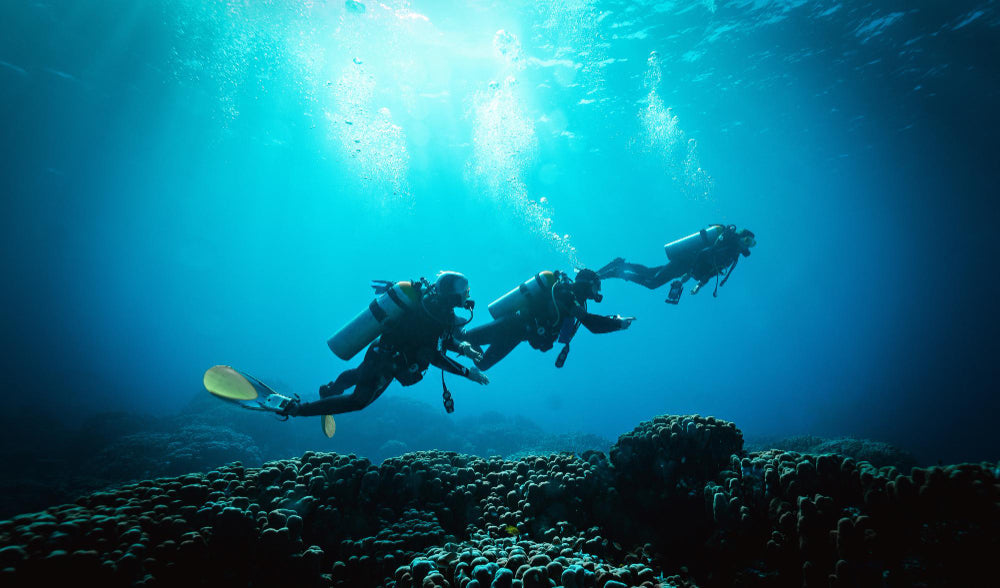
Scuba diving is the activity of breathing underwater using a self-contained breathing apparatus, allowing you to explore the underwater world. For beginners, there are two paths: a "discovery dive" (a single trial dive) or a full course leading to international certification. Safety is top-notch thanks to modern equipment and rigorous training. In Romania, the most popular diving locations are along the Black Sea coast, in areas such as Costinești and Tuzla, where you can explore shipwrecks and unique marine biodiversity.
Scuba diving: everything you need to know to explore the world beneath the waves
Imagine floating in perfect silence, surrounded by soft, diffused blue light. The only sound you hear is your own breath — calm and steady. Schools of silver fish glide past you, and below stretches a mysterious, untouched landscape. This isn't a scene from a documentary — it's the feeling of your very first journey into the underwater world. Welcome to the universe of scuba diving!
What is scuba diving and why does it make an unforgettable gift experience?
Scuba diving is more than a sport — it's a gateway to a completely different world, one that covers over 70% of our planet's surface. It's your chance to become an explorer for a day, to fully disconnect from the noise of everyday life, and to experience the unique sensation of weightlessness, much like that of an astronaut.
Quick answer: Scuba diving means diving underwater using a Self-Contained Underwater Breathing Apparatus (SCUBA). This system allows the diver to breathe underwater without any connection to the surface, providing complete freedom of movement to explore the marine environment.
Giving this kind of experience as a gift isn't just about a fun weekend activity. It means giving a memory that lasts a lifetime, a personal challenge, and a whole new perspective on the world. For a beginner scuba diver, that first breath underwater is a moment of triumph and wonder — one that transforms the fear of the unknown into a passion for discovery.
SCUBA: An acronym for "Self-Contained Underwater Breathing Apparatus." The term refers to the system made up of a compressed air tank and a regulator, which allows the diver to breathe independently underwater.
Is scuba diving dangerous? Busting the myths for beginners
Perhaps the biggest barrier to this adventure is fear — fuelled by movies and exaggerated stories. "What if I run out of air?", "What if I encounter a shark?", "Isn't the water pressure dangerous?" These are all valid questions, but the reality is that modern scuba diving is an extremely safe activity, governed by clear rules and procedures.
Statistics show that it's safer than many sports considered ordinary, such as bowling or jogging. Safety rests on three essential pillars:
- Thorough preparation: No certified diver enters the water without fully understanding the physics and physiology of diving, as well as emergency procedures.
- Modern equipment: Technology has advanced enormously. Today's gear is reliable, features backup systems, and includes clear gauges (manometers) that constantly show how much air you have left.
- The Buddy System: The golden rule in scuba diving is to never dive alone. Your dive partner (buddy) is there for mutual checks and support.
As for marine life, incidents are extremely rare. Most sea creatures are shy and avoid contact with humans. By respecting the environment and following your instructor's guidance, your experience will be one of peaceful coexistence and admiration.
How deep can you go on your first dive?
During a Discovery Scuba Diving programme, the maximum depth is typically 12 metres, always under the direct supervision of an instructor. For Open Water Diver certification, training dives reach a maximum depth of 18 metres.
Scuba diving equipment explained: what you need to know before your first dive
At first glance, the tangle of hoses, gauges, and buckles can seem overwhelming. In reality, every component has a logical and easy-to-understand purpose, contributing to your comfort and safety. For a first dive of the discovery type, all equipment is provided by the dive centre — so there's nothing to worry about.
Here are the core components of scuba diving equipment:
- Mask: Allows you to see clearly underwater by creating an air pocket in front of your eyes.
- Wetsuit: Provides thermal protection. Water — even in the Black Sea during summer — can cool your body much faster than air.
- Fins: Help you move through the water efficiently and with minimal effort.
- Tank: The cylinder containing the compressed air you'll breathe.
- BCD (Buoyancy Control Device): An inflatable vest that lets you control your buoyancy — allowing you to ascend, descend, or hover at a constant depth.
- Regulator: The key piece that connects to the tank and reduces air pressure to a breathable level. It consists of the mouthpiece you breathe through (second stage) and a pressure gauge showing how much air remains in the tank.
There's no need to invest in your own equipment right away. All dive centres offer complete rental packages. The most important thing is to focus on learning the techniques and enjoying the experience.
Taking the plunge: scuba diving course vs. discovery dive
Now that you understand the basics, the question is: how do you actually get started? For a complete newcomer, there are two main paths, each suited to a different goal and level of commitment. The right choice depends on how far you want to take this.
| Feature | Discovery Dive (Intro Dive) | Scuba Diving Course (Open Water Diver) |
|---|---|---|
| What is it? | A single introductory dive under direct 1-on-1 instructor supervision. | A full training programme (theory, pool sessions, 4 open water dives) leading to an internationally recognised certification. |
| Duration | 2–3 hours (briefing + dive) | 3–4 days |
| Maximum depth | 12 metres | 18 metres |
| Ideal for | The curious — those who want to taste the experience. The perfect gift for a one-of-a-kind adventure. | Those committed to making diving a hobby and exploring independently (with a buddy). |
| Outcome | An unforgettable memory and an introduction to the underwater world. | A scuba certification (e.g. PADI Open Water) valid for life, anywhere in the world. |
A discovery dive is without a doubt the best way to find out whether scuba diving is for you. It's a safe, controlled, and thrilling experience — perfect to give as a gift. On the other hand, if your dream is to explore coral reefs in Egypt or shipwrecks in the Mediterranean, a full scuba diving course is the investment you'll need. It's also worth considering the cost of a scuba diving course, which is higher, but grants you long-term freedom to dive wherever you go.
Do I need to be an Olympic swimmer to go scuba diving?
Not at all. You don't need to be a strong swimmer, but you do need basic water skills: the ability to float or tread water for 10 minutes, and to swim 200 metres without stopping — with no time limit. Being comfortable in the water matters far more than speed.
Where can you dive in Romania? Top Black Sea locations
The Black Sea may not have the visibility of tropical waters, but it hides a fascinating world full of history and life. For diving in Romania, our coastline offers some exceptional spots, ideal for beginners and experienced divers alike.
The magic of diving in the Black Sea lies in its mystery. Its darker, cooler waters shelter historic shipwrecks, underwater rock formations, and biodiversity uniquely adapted to this one-of-a-kind environment. The experience is different — more introspective, with a powerful sense of exploration.
The most popular areas for Black Sea diving are:
- Costinești: Famous for the wreck of the ship "Evanghelia," visible from the shore, the area also offers additional dive sites around the wreck, where rich marine life has gathered.
- Tuzla: Home to several sunken wrecks, including the remains of ships from World War II, which have become artificial reefs teeming with gobies, turbot, and sea horses.
- Eforie and Mangalia: These areas feature submerged breakwaters and rocky plateaus that attract a variety of marine species, making them ideal spots for courses and training dives.
Ready to breathe underwater?
The world of silence is waiting for you. Whether you want to give an unforgettable gift or tick something off your own bucket list, the first step is just a click away. Explore our Scuba Diving experience packages and get ready for an adventure that will change the way you see the world.